
On a train between one place and another.
Daffodils on the embankment.
Lambs in a dappled field.
You doze for a minute.
A jolt. You wake up.
The train’s stopped at one place or another.
Bare branches etched on a grey sky.
Winter on the air.
On a train between one place and another.
Daffodils on the embankment.
Lambs in a dappled field.
You doze for a minute.
A jolt. You wake up.
The train’s stopped at one place or another.
Bare branches etched on a grey sky.
Winter on the air.
Our broken blender,
stainless steel and spotless glass,
kept its pride of place
on the black marble countertop
for a full decade –
a household deity, sadly defunct.
So one day I decide
to take it to where superannuated
blenders go – but
in a gesture of not quite farewell
I plug it in and
turn the knob one final time.
A shudder, a shake,
a rattle, a rumble: a resurrection
right here in the kitchen.
And the blender, reinstated, sits
in its corner,
a serene benevolent buddha
surveying our comings
and goings as we near our own
fatal malfunction,
and from time to time rouses
itself, roars into life,
regales us with a raspberry shake
and a message:
You may feel faulty or rusty,
a reject –
but hey, why not give it
one last whirl
before someone pulls the plug.
(The line in a gesture of not quite farewell
was lifted from Robert Rehder’s On the
Nature of Physical Law)
The line “in a gesture of not quite farewell”
was lifted from Robert Rehder’s
On the Nature of Physical Law
In each of our lives
everyone else is a tourist.
I wonder do they find
what the brochure promised:
sights, decent food, cheap booze –
or even the experience of a lifetime?
Back home, are they going to
print out their pictures
and hang them on empty walls?
Will they share the experience,
send others my way?
Should I consider refurbishing?
Though – they say the locals
in the summer resorts can’t wait
for the rains, the cool weather and
the shutters coming down for winter.
Sometimes I think I can almost
feel the weather turning.
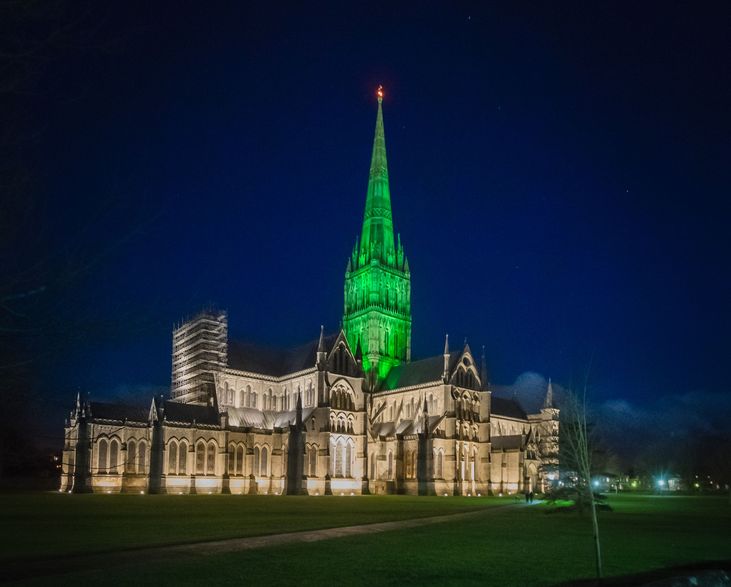
Some people say an ancient race landed
a spaceship here a thousand years ago.
They sent out scouts; explored the land;
settled, and tilled the soil. Then famine came,
and war. All memory ends here.
The travellers are gone; their ship, forgotten.
Until tonight. Tonight I walk the length
of the great hull. Anchored by buttresses,
pinned down by rusty scaffolding, it lies
a prisoner under an alien sky, the spire
straining to make contact with the stars.
A late car passes in the rain. Lights flicker
on the walls. I hear the swish of tyres
on wet tarmac; the hum of mighty engines
waking up. The ship is stirring. Timber
creaks; a finial falls, a flying buttress
scatters Purbeck stone, the sheer sides
soar up, vanish into space –
I shut my eyes – and it is nothing –
just a tale – as insubstantial as the wind
that shakes the chestnut trees and chases
leaves across the black, deserted Close.
Nobody seems to know why the Vikings came
to L’Anse aux Meadows. Surely not
for the meadows (no grass here), nor
the grapes the Vinland of the ancient saga
conjures up (no grapes). I blame
the boredom of interminable winter night,
the Norse testosterone egged on by mead.
Maybe they didn’t come at all –
the experts differ. But here we stand,
stooped in a spick and span,
faithfully reconstructed sod house.
The Basques, though,
they were here for sure,
across the Strait in Labrador.
A hundred years of slaughtering
the Right Whale, pouring him in barrels
to illuminate the salons of old Europe.
We visited the traces of their trade
in Red Bay, and saw a few survivors
(whales, not Basques: they all were home
by sixteen hundred.)
So were the Portuguese from Bonavista –
more canny than the Irish and the Welsh,
the Dorset men and those from Devon
who kept returning season after season,
then left their homes for good,
built shacks, a fish flake to eke out
precarious livings salting cod
until the fish was finally gone
from Newfoundland –
and now it was the outporters
themselves who were hung out to dry,
uprooted once again, their salt box homes
abandoned, shattered windowpanes
inviting in the fog… Fuck Off ’s the message
globalisation sends to Newfoundland,
and those who have a soul to sell jump ship
to drill for oil in Fort McMurray.
For those whose soul’s not marketable
there’s a shop in Water Street, Fog Off,
that sells cool sweaters to keep tourists warm
and gives a share to charity:
for those whose minds fog up
with alcohol, with drugs and
homelessness in a lost land.
They say it’s about dignity.
A throwback to the dark ages,
denying four centuries of civilisation.
Their newspapers write about
human rights, and that faith, though
sacred, must learn to compromise.
They talk of enslavement:
it strips us of all individuality and
reduces us to chattels, they say.
Look, they whisper, there goes one.
I can’t think how they can submit
to such humiliation.
It frightens their children, they say,
and there’s something sinister
in not daring to meet face to face.
I walk their streets, safe
in my black oubliette. Thick cloth
softens whispers; the grille
in front of my eyes shuts out
their exposed flesh, shameless
behaviour, brash looks. Yes,
I have wondered what it’d be like
to feel free. But I tell myself,
Better the devil you know.
A blackbird binds the fragments of dreams
with the twine of his song;
a scattered archipelago of reality
emerges from the night:
clang of dawn deliveries; rumble
of dustmen’s carts on cobblestones;
the dragging steps of the Golem
after a night’s watch over his precarious city.
That was long afterwards, though. Where I was now
was just wanting to get her to stop,
stop the car on that narrow lane on a Welsh hillside
whose name I’ve forgotten
like the reason for our insane quarrel, or where I found
the recklessness that made me
open the door of a car driving along a narrow lane
on a Welsh hillside, jump outside
while she was still slowing down, bang the bonnet
and leave a dent that we both,
separately, secretly, worried about for the rest of
that holiday, because of course
we hadn’t taken out extra insurance for the rental car,
as you do when you are young
and still trust in things mostly turning out right, and still
capable of insane, inexplicable emotions
that will make you jump from a car on a Welsh hillside
and write a story afterwards,
long afterwards, a story about a man skipping stones
over the surface of a twilight pond,
about two people walking through endless cornfields
towards the grain silos of a sleepy town
somewhere in the dusty Midwest of the United States;
a story about love.
The cheerful confusion
of unidentified dawn birds,
punctuated by the bisyllabic
cackle of pheasants.
A little bird has dreamed
a strange amphibian dream
and practises a timid
ribbit – ribbit?
A blackbird and his rival
soar above the chorus;
another pheasant screech,
followed by heavy flutter.
A goose honks, once.
The ribbit has grown in confidence.
On a bleak beach
on the far side of the leaden Atlantic
an ungainly creature –
a huge sinister crow
assembled from canvas and metal struts –
hops, hesitates,
takes a desperate run,
lifts off towards lowering clouds and
plops back onto wet sand;
runs, rises, dips,
rises again to thin cheers, and flies
a short length of
the desolate beach.
Against the swell of the decades
I want to swim that ocean,
heave great boulders
into the obscene creature’s path –
let it crash. Let their dream
founder. Maybe then
there would have been no news
from Halifax today.
 whypoetry