Category Archives: Places

On Washington Crossing the Delaware

Not today, though,
in the Metropolitan Museum of Art,
not today he isn’t.

The entrance to the room
is barricaded with plywood permitting
only a partial glimpse

of the General: upstanding, unfazed
by the turbulent ice floes,
unwavering gaze fixed on, well,

plywood. The impeccable turnout,
in democratically dun-coloured mantle
(lined with scarlet),

thrown in dramatic folds
over shoulders bearing the weight
of a nascent nation –

all for nothing today. He shall not
reach the far shore, shall not
trounce the Hessian mercenaries;

and this great nation shall never,
now, be birthed – and not
just this room, no, the entire museum,

Fifth Avenue, all of Manhattan
declared closed
for the duration; New York roped off,

the Empire State Building un-built,
stone by stone, steel girders
dismantled, the Brooklyn Bridge

melted down and Brooklyn cut loose
to drift out to sea.
By and by the prairie schooners

will return from the West (California
now only a word
whispered in feverish dreams

and no more), and from a non-place
not called Washington,
in a porticoed, pillared white house

that never was, a last tweet proclaims
the fading usurper’s futile fury –
then silence. Peace.

Washington Crossing the Delaware


Ellis Island

Sofia, age 23, from Siberia:
processed in Ellis Island, 1921;
destination Gackle, North Dakota.

You have to wonder.

Gackle, North Dakota:
founded in 1904;
located at 46°37′38″N, 99°8′36″W:

not even the middle of nowhere.

Population (1920): 424.
Population (1950): 606.
Population (2016): 291:

not exactly Boomtown ND.

Things to do in Gackle ND:
ˮGackle is home
to the Gackle Public Libraryˮ –

that is about the extent of it.

They must be doing
an awful lot of reading
up there in Gackle, ND.

And you have to wonder:

Did she find her home there?
Was it worth the loss of loved ones,
the heartbreak of exile, the long journey

all the way from Siberia – to Gackle, ND.


Walking on Thin Air

You will never be standing
on that impossibly thin line
four hundred metres
above the ground
between the two towers –

oh but you will:

all of us will, or were,
or are (even now),
only we did not realise then,
or have forgotten,
or choose to close our eyes

to the immensity of the drop.


(On 8/7/1974, Philippe Petit walked  the tightrope betweeen the twin towers of the World Trade Center.)


John Brown in the Met

The Old Testament beard blows
in the gale of a mighty shout;
the hair on his head raised
by the sheer force of fury; eyes
rolling under the promontory
of a frowning brow; brawny arms
outstretched in righteousness
burst the confines of the canvas –

This John Brown is anything but
a-mouldering in the grave.

This giant is girded with pistol
and sword; this prophet’s rage
raises tornados; this patriarch
dwarfs all who come near –
the settler unaware of the storm
bearing down on his wagon;
the cowering negro looking up
to the saviour that towers above him.

John Brown in the Met

This John Brown is a soldier
in the Army of the Lord indeed,

and that his soul goes marching on,
of this the artist allows no doubt.
But that is not the question.
The question is whether
the voice of the black man
for whom this storm was raised
can be heard over the giant’s shouting –
if he can ever make himself understood

over the endless deafening chorus of
Glory, glory, hallelujah, Glory, glory hallelujah …


New York Scenes

New York Scenes


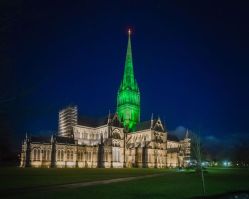
Salisbury Cathedral

459288

Some people say an ancient race landed
a spaceship here a thousand years ago.

They sent out scouts; explored the land;
settled, and tilled the soil. Then famine came,

and war. All memory ends here.
The travellers are gone; their ship, forgotten.

Until tonight. Tonight I walk the length
of the great hull. Anchored by buttresses,

pinned down by rusty scaffolding, it lies
a prisoner under an alien sky, the spire

straining to make contact with the stars.
A late car passes in the rain. Lights flicker

on the walls. I hear the swish of tyres
on wet tarmac; the hum of mighty engines

waking up. The ship is stirring. Timber
creaks; a finial falls, a flying buttress

scatters Purbeck stone, the sheer sides
soar up, vanish into space –

I shut my eyes – and it is nothing –
just a tale – as insubstantial as the wind

that shakes the chestnut trees and chases
leaves across the black, deserted Close.


Newfoundland I

Nobody seems to know why the Vikings came
to L’Anse aux Meadows. Surely not
for the meadows (no grass here), nor
the grapes the Vinland of the ancient saga
conjures up (no grapes). I blame
the boredom of interminable winter night,
the Norse testosterone egged on by mead.
Maybe they didn’t come at all –
the experts differ. But here we stand,
stooped in a spick and span,
faithfully reconstructed sod house.

The Basques, though,
they were here for sure,
across the Strait in Labrador.
A hundred years of slaughtering
the Right Whale, pouring him in barrels
to illuminate the salons of old Europe.
We visited the traces of their trade
in Red Bay, and saw a few survivors
(whales, not Basques: they all were home
by sixteen hundred.)

So were the Portuguese from Bonavista –
more canny than the Irish and the Welsh,
the Dorset men and those from Devon
who kept returning season after season,
then left their homes for good,
built shacks, a fish flake to eke out
precarious livings salting cod
until the fish was finally gone
from Newfoundland –

and now it was the outporters
themselves who were hung out to dry,
uprooted once again, their salt box homes
abandoned, shattered windowpanes
inviting in the fog… Fuck Off ’s the message
globalisation sends to Newfoundland,
and those who have a soul to sell jump ship
to drill for oil in Fort McMurray.

For those whose soul’s not marketable
there’s a shop in Water Street, Fog Off,
that sells cool sweaters to keep tourists warm
and gives a share to charity:
for those whose minds fog up
with alcohol, with drugs and
homelessness in a lost land.


Newfoundland II

A strange place, this –
and what a lucky find!

The right whale, codfish, seals:
mysterious plenty
at the rim of nothingness,
a mirage found in ice and fog,
free for the taking,

and taken –
by Basques and Bretons,
Welshmen, Irish,
men from Dorset, Devon.
A new found land –

paid for in shipwreck,
frozen limbs,
exile and loneliness,
abandoned homes,
deserted hearts.

A strange place, this.
The sadness of a lucky find.


El Horcajo

The hills like dusty waves –
and that’s an eagle, surely,
floating over El Horcajo.

A herd of black pigs
snuffle close to greet the car
along the bumpy track.

Dishevelled chickens
stalk the courtyard
stabbing at grains of corn.

Behind the wire-mesh window
a yellow digger dozes
in the evening sun.

Dusk, and a restless bird calls
in a foreign language.
On the edge of sleep

the sound of phantom cowbells.
In the small hours
thin dogs howl from hill

to distant hill:
discordant whale song
in this sea of soil.


Cotswold Graveyard

Grey stones
under a grey Cotswold sky:

fading letters
summing up faded lives;

and the roofs
beyond the graveyard:

grey stone
under a grey Cotswold sky.